Award Winner
Hamilton Urban Forest Climate Vulnerability Analysis
Climate-Driven Vulnerability Assessment & Urban Forest Replanting Strategy
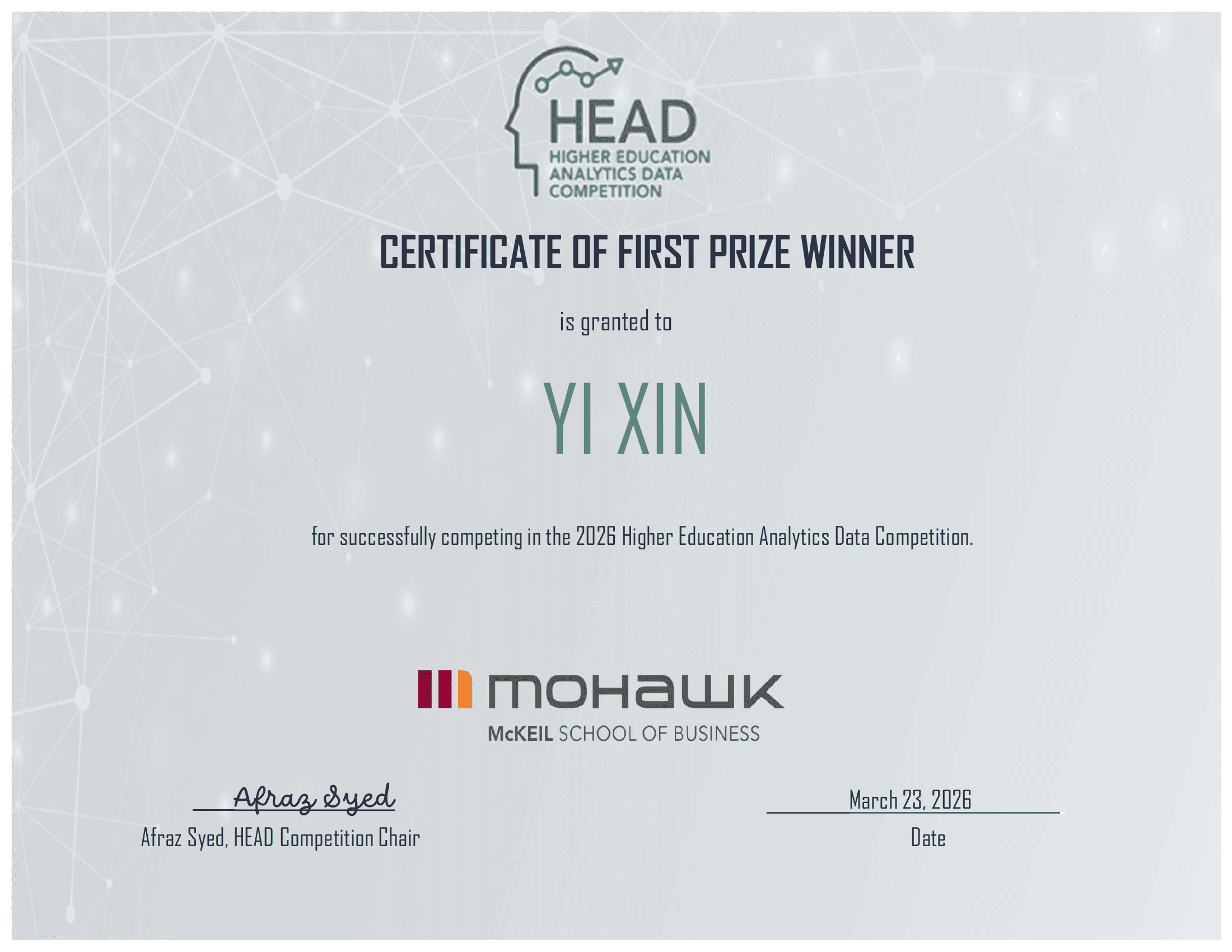
First Prize
H.E.A.D. Competition 2026
Hosted by Mohawk College · McKeil School of Business
University of Niagara Falls Canada · March 23, 2026
H.E.A.D. (Higher Education Analytics Data Competition) is a cross-institution analytics competition hosted by Mohawk College's McKeil School of Business, requiring teams to deliver end-to-end data analysis projects under time pressure.
Team Members · Team #20
- Susana Carolina Romero Aparicio
- Su Myat Aung
- Tessy Ramirez
- Yi Xin(me)
Data Engineering
Built a multi-source ETL pipeline integrating tree inventory, climate records (1866–2026), species resilience DB, land use classification, and road network data.
API Integration & Validation
Queried GBIF Backbone Taxonomy API with exact + genus-fallback matching for 299 species, achieving complete family classification across 275K records.
Statistical Modelling
Implemented IPCC AR5 vulnerability equation (Exposure + Sensitivity − Adaptive Capacity) with ISA heat-index amplification for 2030, 2050, and 2080 projections.
Visualization & Decision Support
Delivered ward-level vulnerability maps, Santamour diversity diagnostics, and species replacement priority models — translating analysis into an actionable replanting plan.
Highlight 1
Climate Trend
Hamilton's temperature record from 1866 to present. Under SSP2-4.5, summer mean temperature is projected to rise +4.47°C by 2080, accelerating urban heat stress.
Highlight 2
Vulnerability Evolution
Ward-level vulnerability scores evolving from 2030 → 2050 → 2080. Ward 3 rises from 0.956 to 1.423, establishing itself as the highest-risk zone.
Highlight 3
Replanting Strategy
Priority replanting model combining built-environment stress, climate vulnerability, and biodiversity pressure. Recommends 10 high-resilience species — 9 from new genera, breaking Acer dominance.
Invited to Winter 2026 CityLAB Project Showcase
April 7, 2026 · 1:00 PM – 3:30 PM · 58 Jackson St W · CityLAB Space
As first-prize winners of H.E.A.D. 2026, our team was invited by CityLAB to present at the Winter 2026 Project Showcase. We prepared an infographic poster and a 3-minute presentation to share our Hamilton Urban Forest Climate Vulnerability Analysis with urban planners and community partners.
Interactive Infographic
View full size on Canva↗