Act 1 · A person refuses · 01
The method has to fit what you already know
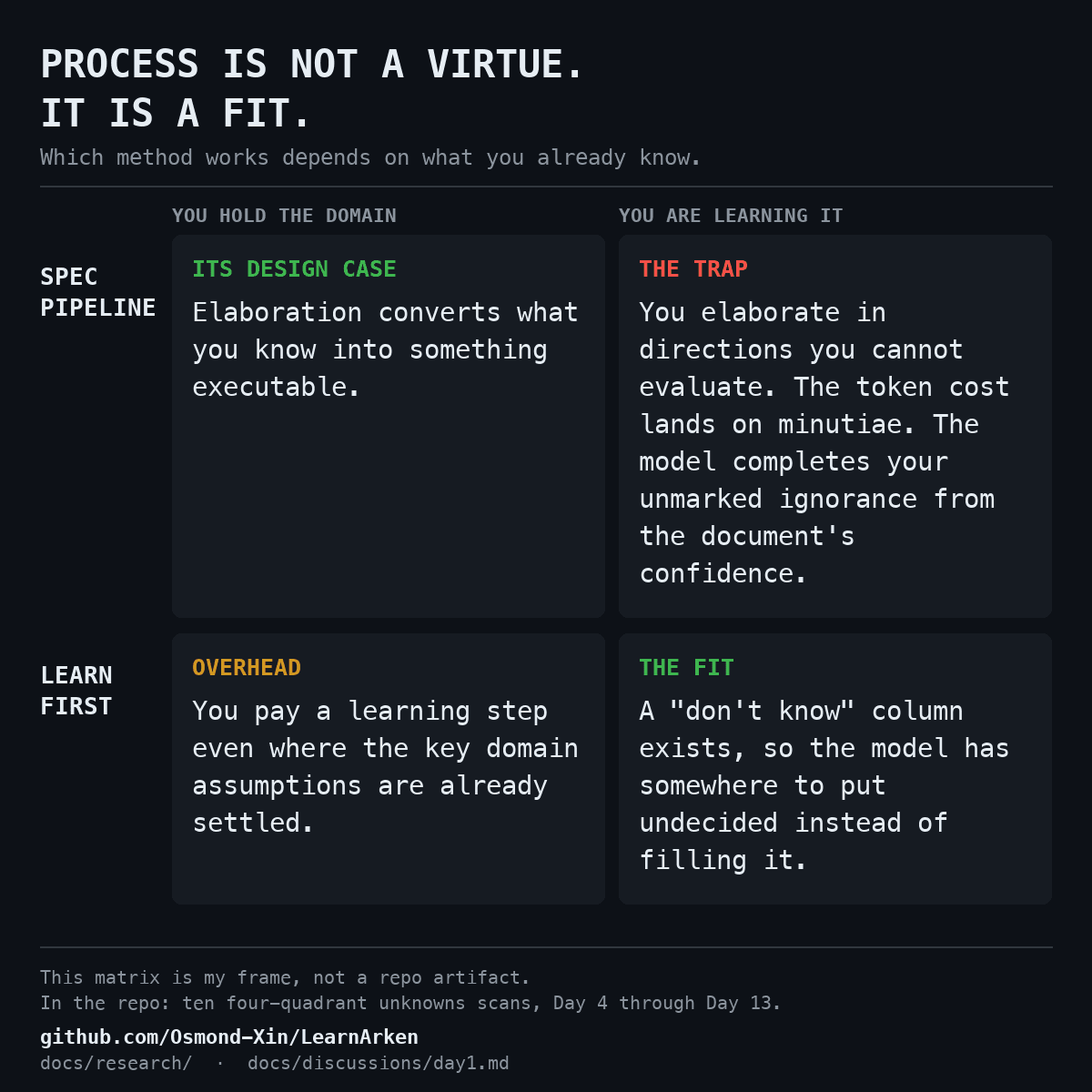
Below is the post exactly as published on LinkedIn, unchanged.
I dropped the spec framework on day one of this project. It took me until day four to understand why.
TL;DR — I kept answering spec questions I was not qualified to answer, because the format had nowhere to write "I don't know yet". That silence is what the model built on.
The project: answering questions out of aircraft maintenance manuals, where a confident wrong answer is worse than no answer at all. One person. Originally ten days. Synthetic data, toy scale. I had used a spec-first pipeline before, on work where I knew the domain cold, and it was good. So I opened it here too.
Then it started asking me to decide things.
Not big things. Branches. Edge cases. Each answer was cheap to produce and impossible for me to judge. The pipeline kept asking. The tokens kept going. And at the end I was holding a document set that read as decided.
So I stopped using it. On day one I could not have told you why — I only knew the bill was large and the confidence was fake.
Three days later, reading a piece on naming your unknowns, I got it. The framework was never the problem. That kind of pipeline is strongest when the designer already holds the domain. Give it one and it turns what they know into something executable. I was not that designer. I was learning.
And here is the part I did not see coming. When a spec sounds settled about something its author has not actually understood, the model does not stop and ask. It completes from the document's confidence. Not from mine — the document's. Where I was unsure, the document gave the model certainty.
Unmarked ignorance is not neutral context. It is the most reliable place for drift to enter.
So from day four, before any implementation, I write down what I don't know. Then I go hunting for what I didn't think to write down. The list isn't the point. The point is that the column exists, so there is somewhere to put undecided.
Day seven I skipped it. Built first, scanned after. The file says so on its own first screen.
One more thing, if you want to check any of this. The reason I just gave you is not the reason my own day-one record gave for almost three weeks. I had approved a different one, believed it, and only caught it when an earlier draft quoted it back at me. The correction went in this week, with the old wording left sitting above it.
Process is not a virtue. It is a fit.
What a reader takes away
Unmarked ignorance is not neutral context — the model completes it from the document’s confidence. A method with nowhere to record “I don’t know yet” converts your blind spots into drift.
Check it yourself
Each pointer opens a real file on the LearnArken repository’s main branch.